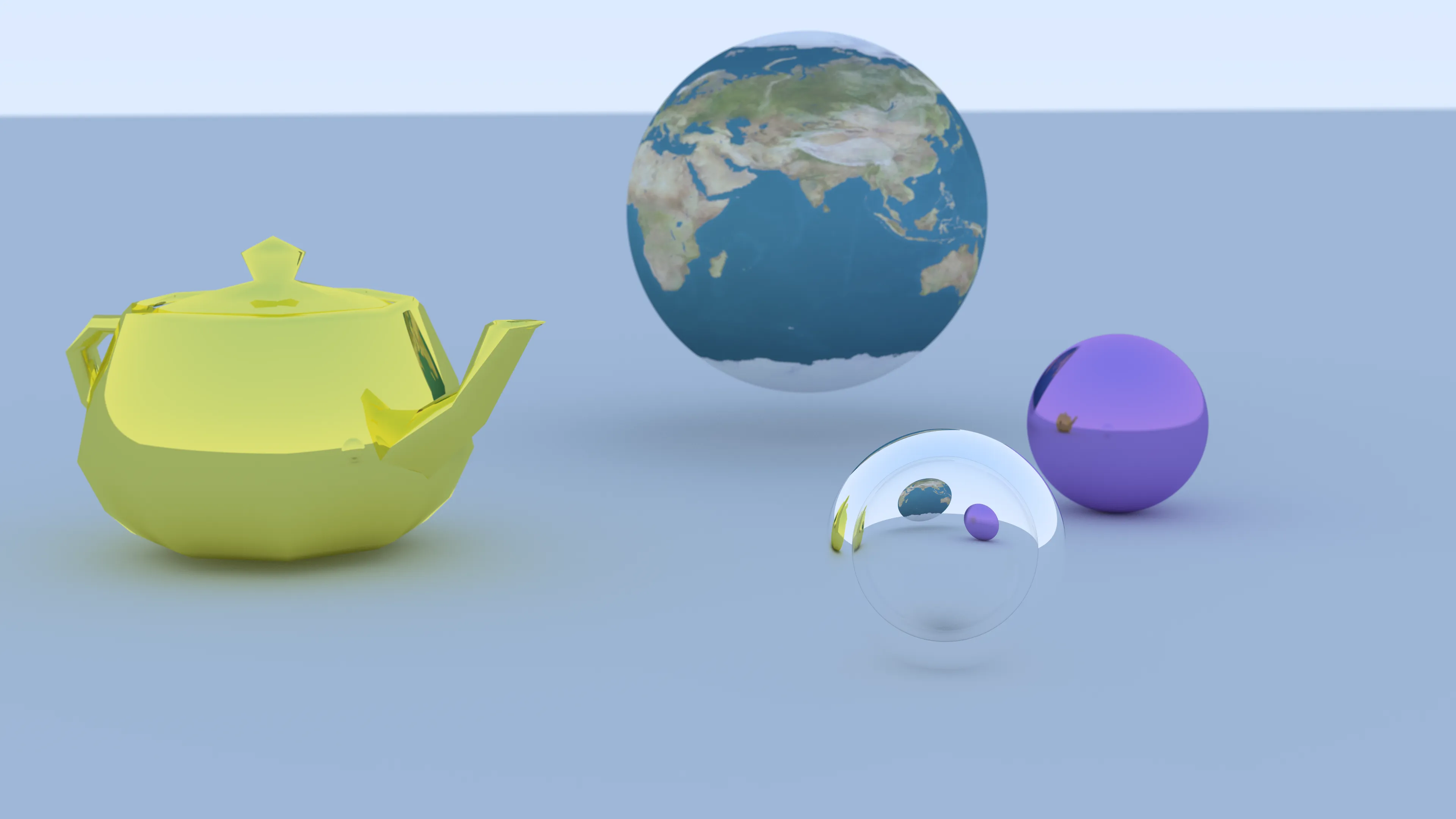
Rust Ray Tracer
15/10/2024
Introduction
This project is a ray tracer implementation in Rust, following Peter Shirley’s book “Ray Tracing in One Weekend”. The goal was to learn more about computer graphics fundamentals while taking advantage of Rust’s performance and safety features.
What is Ray Tracing?
Ray tracing is a rendering technique that simulates the way light travels in the real world. By tracing the path of light rays as they bounce around a scene, we can create photorealistic images with:
- Realistic reflections and refractions
- Natural shadows and lighting
- Depth of field effects
- Anti-aliasing for smooth edges
Key Features Implemented
- Basic ray-sphere intersection: The foundation of the ray tracer
- Multiple materials: Lambertian (diffuse), metal, and dielectric (glass) surfaces
- Camera with adjustable FOV: Control the perspective and field of view
- Antialiasing: Multiple samples per pixel for smoother images
- Positionable camera: Look at the scene from any angle
pub struct Ray {
    pub origin: Vec3,
    pub direction: Vec3,
}

impl Ray {
    pub fn at(&self, t: f64) -> Vec3 {
        self.origin + t * self.direction
    }
}
Performance Optimisations
Rust’s zero-cost abstractions made it possible to write clean, readable code without sacrificing performance:
- Parallel rendering: Used the
rayoncrate to parallelize pixel rendering across CPU cores - SIMD operations: Leveraged Rust’s type system for vectorized math operations
- Memory efficiency: No garbage collection overhead, predictable performance
use rayon::prelude::*;

let pixels: Vec<Color> = (0..height)
    .into_par_iter()
    .flat_map(|j| {
        (0..width).into_par_iter().map(move |i| {
            render_pixel(i, j, &world, &camera, samples_per_pixel)
        })
    })
    .collect();
Materials and Shading
Implementing different material types was one of the most interesting parts:
- Lambertian (Diffuse): Scatters light randomly in all directions
- Metal: Reflects rays with optional fuzziness for realistic metallic surfaces
- Dielectric: Handles refraction for glass-like materials using Snell’s law
pub trait Material: Send + Sync {
    fn scatter(&self, ray: &Ray, hit: &HitRecord) -> Option<(Color, Ray)>;
}

pub struct Metal {
    pub albedo: Color,
    pub fuzz: f64,
}

impl Material for Metal {
    fn scatter(&self, ray: &Ray, hit: &HitRecord) -> Option<(Color, Ray)> {
        let reflected = reflect(ray.direction.unit(), hit.normal);
        let scattered = Ray::new(hit.point, reflected + self.fuzz * random_in_unit_sphere());

        if scattered.direction.dot(&hit.normal) > 0.0 {
            Some((self.albedo, scattered))
        } else {
            None
        }
    }
}
Results
The final ray tracer can render complex scenes with multiple objects, materials, and lighting in reasonable time. A 1920x1080 image with 100 samples per pixel renders in about 2-3 minutes on a modern CPU.
Next Steps
Future improvements I’d like to implement:
- Bounding Volume Hierarchies (BVH): Speed up ray-object intersection tests
- Texture mapping: Add support for image textures on surfaces
- More primitives: Triangles, boxes, and mesh loading
- GPU acceleration: Port to Vulkan or WGPU for real-time rendering